

Welcome back to the fall art season, where absolutely nothing has changed and, in fact, conditions may have worsened. This week alone there were over 100 openings, which is physically and psychically impossible unless you have Olympic-level art gallery stamina, a personal driver to get you from the UES to Chinatown in under 30 minutes during rush hour, and the ability to arrive with virtually no upper-lip sweat and several fully formed opinions.
School is literally back in session too. I am in week two of being forcibly returned to higher ed against my will, and what I can report back so far is that the kids aren’t OK. Only a third of them did the reading this week. WTF is going on? You just had an entire summer, kids.
Meanwhile, I am running around campus like a bat out of hell trying to wrangle undergrads, make lesson plans, produce Daddy content and somehow maintain a career in journalism. None of the above appears to be going particularly well.
Then there is opening week itself: saying hello to people you haven’t seen in six months, being unable to swing your tote bag over your shoulder on a Tribeca sidewalk without hitting someone, then being sidewalked to death by someone in Chelsea the next night while they chain-smoke and pretend they don’t see you.
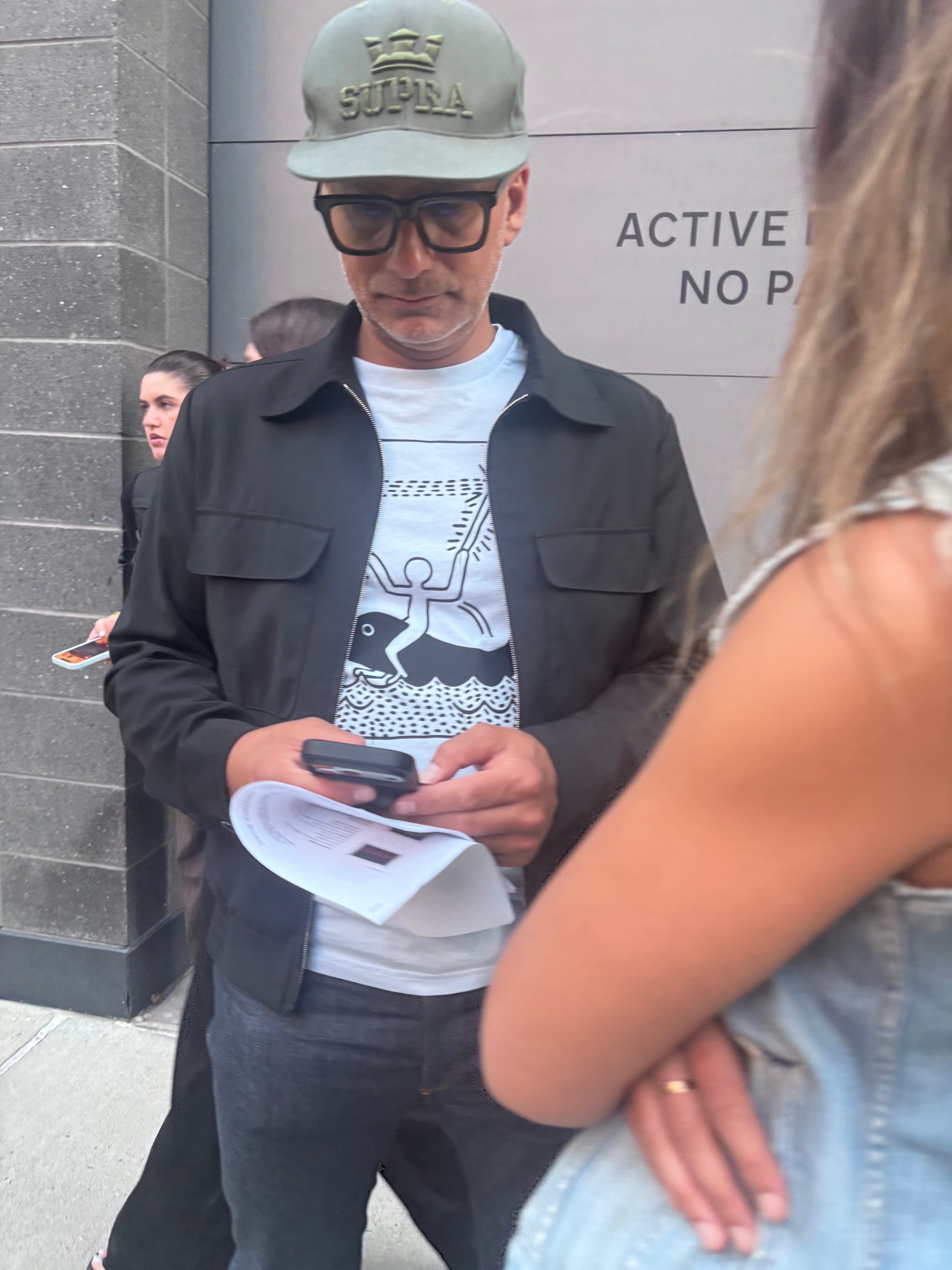
I used to love an opening. The energy, the wine, the people, the brief whiffs of secondhand smoke you can inhale as an ex-smoker. I would be delighted by the daddies I’d see. Don’t get me wrong, I still love a good opening and a good party. But maybe after a summer of everyone maximalizing absolutely everything, my own fall dread, and my increasingly deranged sleep and martini schedule have finally caught up with me. I want to be in bed by 8 and will make plans to see you after September has passed. Unfortunately, the art world, my alleged social media presence and the inconvenient fact that there are still a few people I actually want to see, had other plans for me.
So Daddy is going back to her roots. This week’s dispatch is not gossip-heavy or industry-headline-driven. This is Daddy in the field during the first week of NYC art season and cursed NYFW: art, daddies, crowd control, social clout, sidewalk warfare, the vibe of the room, who I saw, what I saw and what I thought. And she is feral and has opinions.
Over two nights, September 9 and 10, I deployed my tactical plan, used the list I created, made plans to meet friends and unleashed myself into the Hunger Games of NYC fall art season. And this is what transpired.
Wednesday, September 9, 6:43 p.m.
This used to bring me unbridled joy. Now crowds give me anxiety, and when I literally have to take my tote bag off my shoulder to shimmy through a crowd, I am audibly saying under my breath, “What the fuck am I doing here?” Now something has to earn my attention.
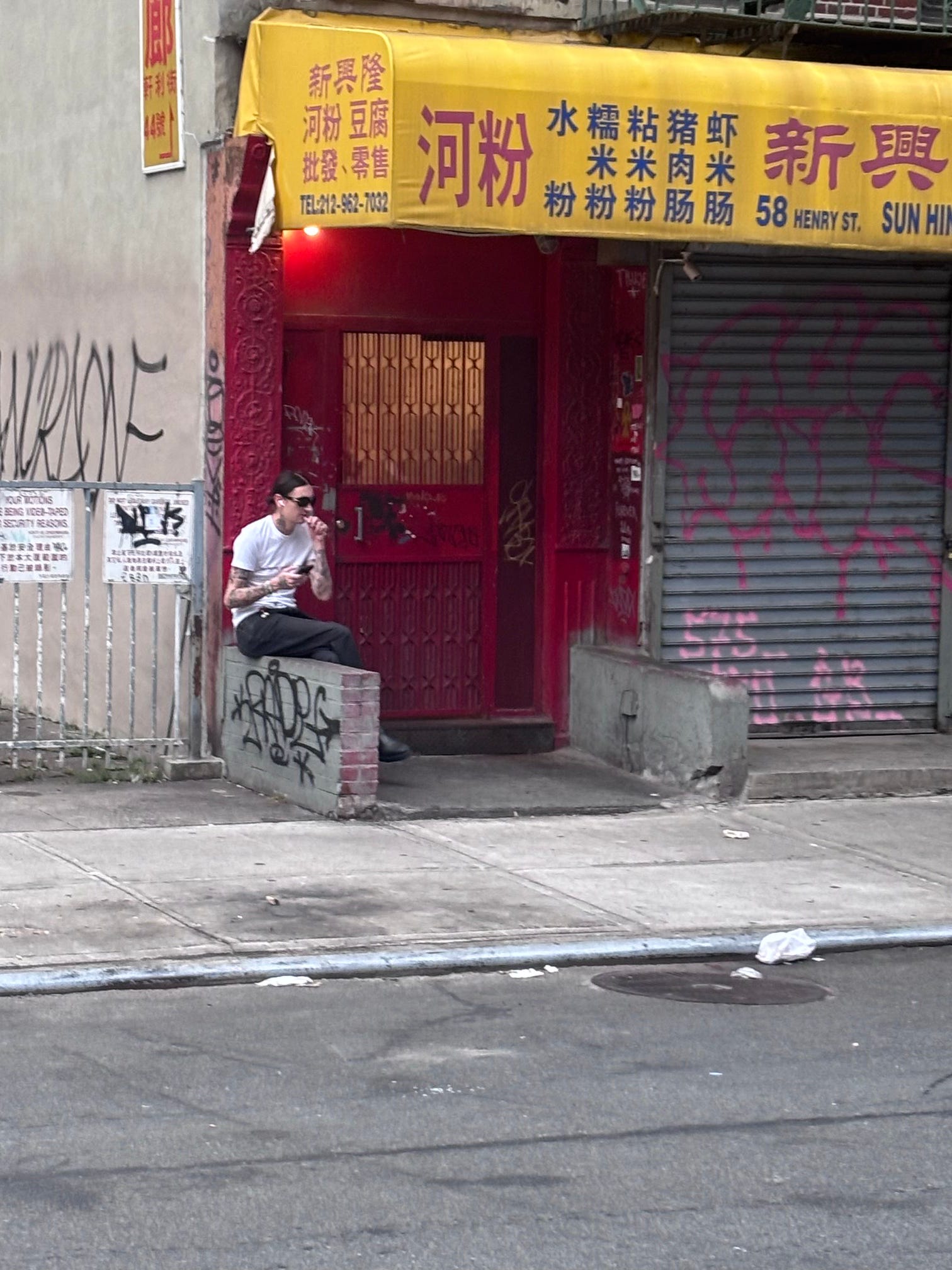
I start with the farthest galleries first, on Henry Street. Post-Covid, galleries have been cropping up here for the better part of six years, mushrooming across Chinatown in storefronts and spaces that still feel slightly removed from the larger machinery of the NYC art world. The scrappy ones that have managed to hang on have, in my opinion, some of the most exciting programming in the city.
I think that’s part of why these galleries have continued to take bigger risks. Chinatown has maintained an up-and-coming energy and a grittiness that feeds directly into the bloodstream of these spaces. While the rest of the art world has spent the summer on vacation, presumably moisturizing somewhere expensive. Starting here feels like the right move.
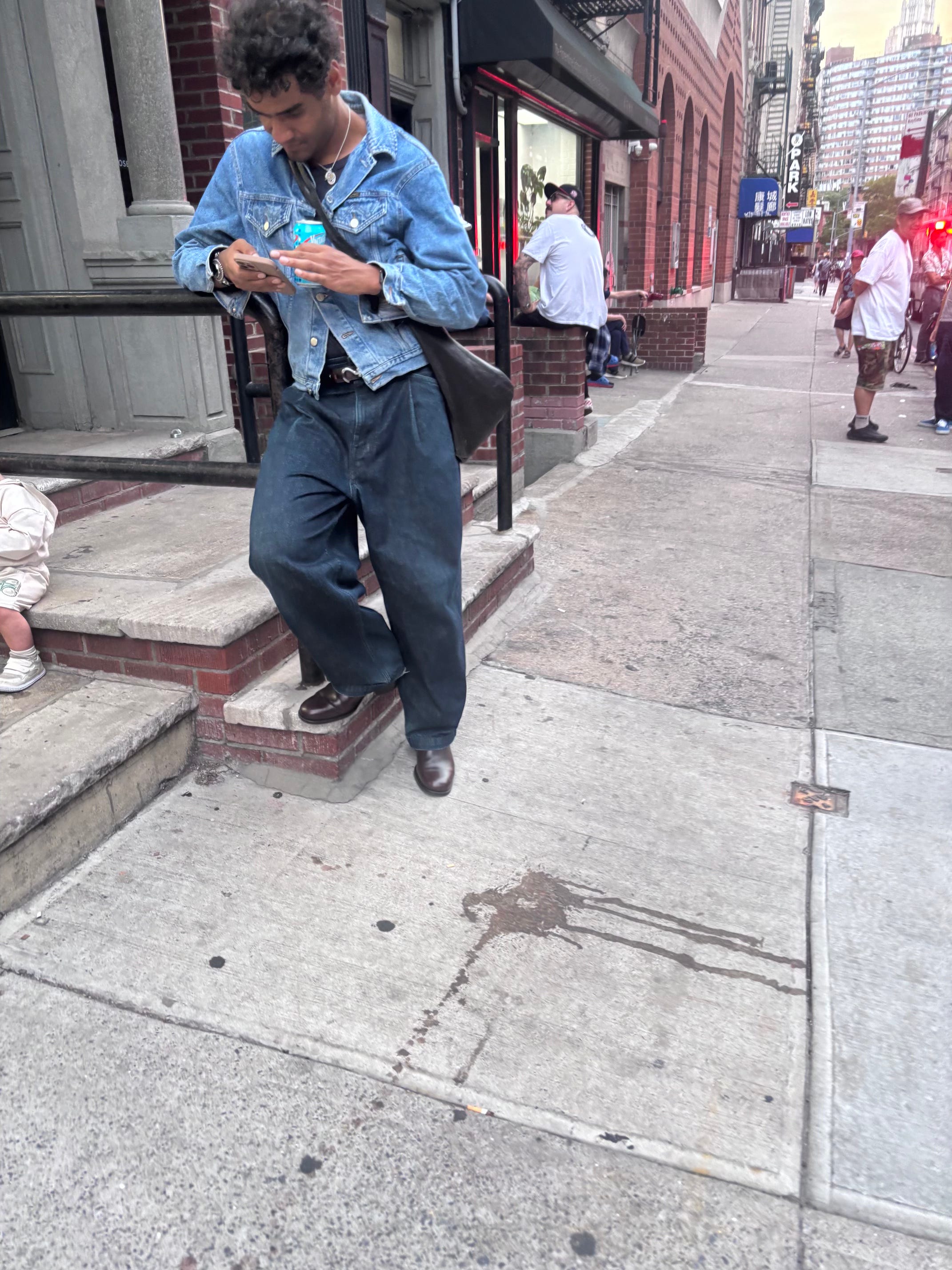
I am no stranger to sidewalks six people deep during an opening in this part of the city. People spill out onto the street, smoke cigarettes, talk, drink Budweisers from coolers and wine from plastic cups, and somehow maintain an air of downtown cool that even a decomposing rat two feet away in a sewer drain can’t kill.
I arrive around 6:40 p.m. The crowds are lighter than I expected, which is exactly what I need to ease myself in. It feels almost polite. Nice, even grown-up. Nobody has elbowed me in the tit. I pop into a few smaller galleries that aren’t on my list, weave between the crowds and make my way toward what I really came out to see: Post Times and Hair and Nails.
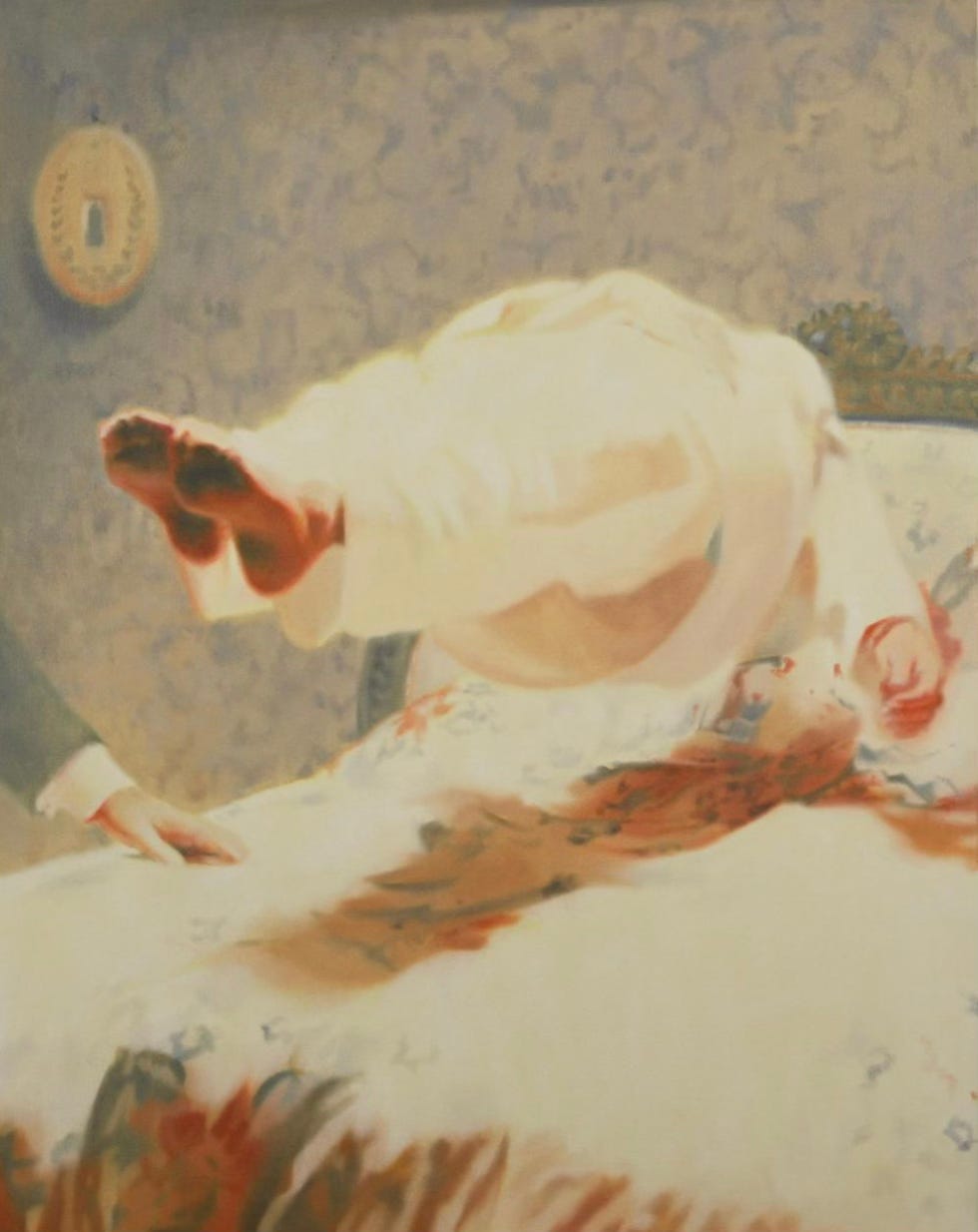
Hair and Nails has a large crowd assembled along the sidewalk and on the steps. Open through September, the gallery is featuring a solo exhibition of Emma Beatrez. The works demand attention but maintain a strange quietness. Operating somewhere between memory, dreamscapes and the unconscious, the paintings have the quality of old photographs, where colors fade but fashion choices remain forever imprinted on the image. Carousels, levitating women, cheerleaders and other imagery make the viewer question not only what they are actually looking at, but the lived realities they use to make sense of what they see.
I leave the gallery with Lacan on my mind, thinking about psychic lack, because apparently this is what I do for fun now. Less than two minutes later, artist Glenn Goldberg emerges on the sidewalk like an art-opening vision quest. Goldberg, a born-and-bred New Yorker, has maintained a prolific studio practice for the last 40 years while also teaching at Parsons and Queens College.
Glenn had just emerged from a video installation at Post Times, and we shoot the shit about fall in NYC, his recent Phillips collaboration and teaching. We say our goodbyes, and I make my way inside, where I am instantly taken aback.
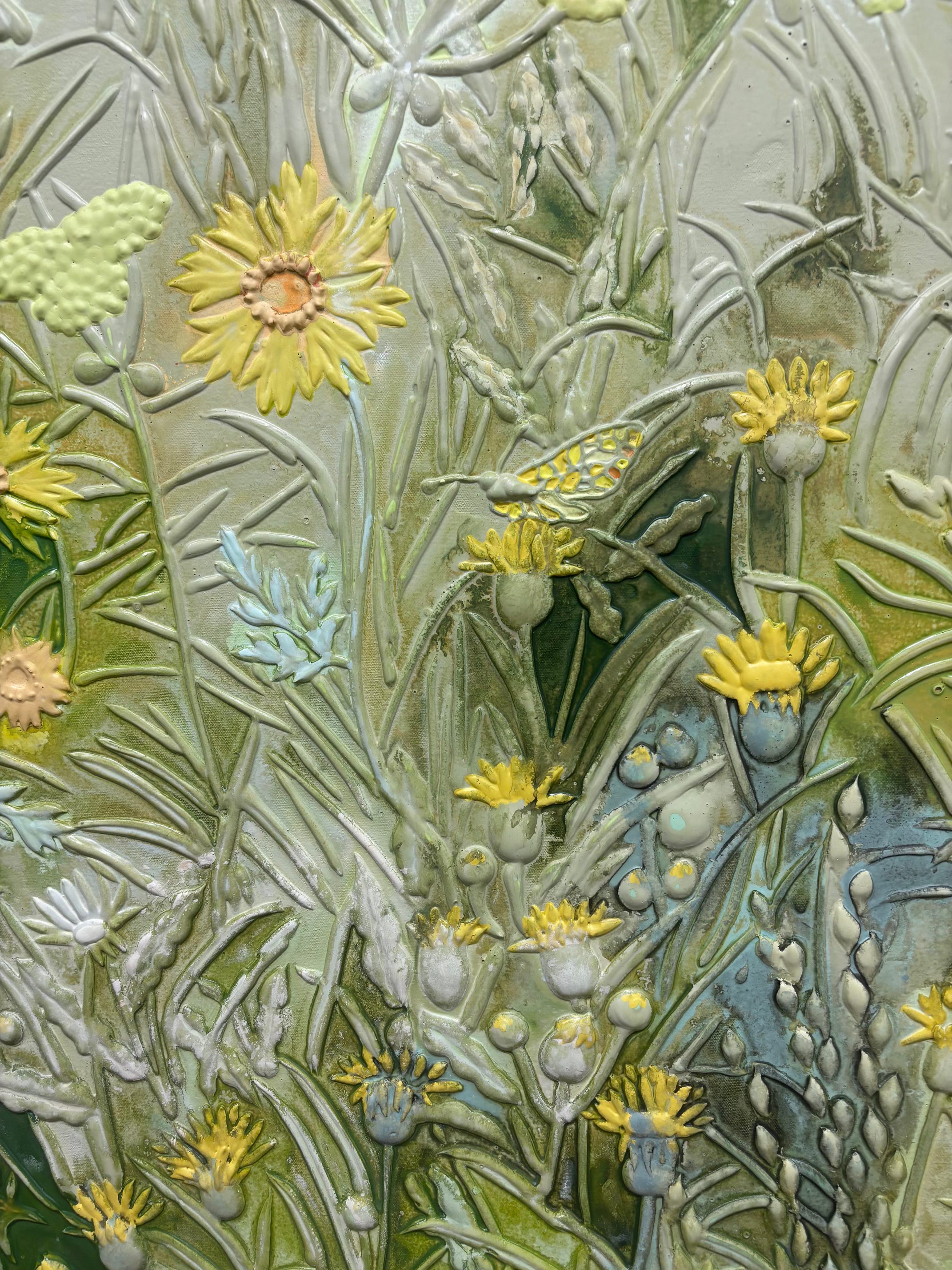
I walk into the gallery and am drawn to the large and small paintings that dot the front exhibition space and continue into the back, part of a solo show by Michael Assiff. Many of the works maintain a muted palette of chartreuse, mint green, butter yellow and other tones, from which plants and flowers emerge.
The works were created during a road trip Assiff took with their friend Ramblin, a long-haul trucker. Traveling with Ramblin, Assiff became inspired by the vegetation found at truck rest stops and made drawings that would eventually become the paintings for this exhibition. Together, the paintings become a kind of botany study of the weeds, plant life and vegetation the artist encountered along the way.
Assiff’s approach to painting is part sculpture, part cake decorating and part controlled environmental disaster. The resulting works are sculptural canvases that recall the palette and surfaces of 1970s ceramics and vintage Pyrex casserole sets. The works maintain a kind of nostalgia while also acting as postcards, snapshots of where the artist has been.
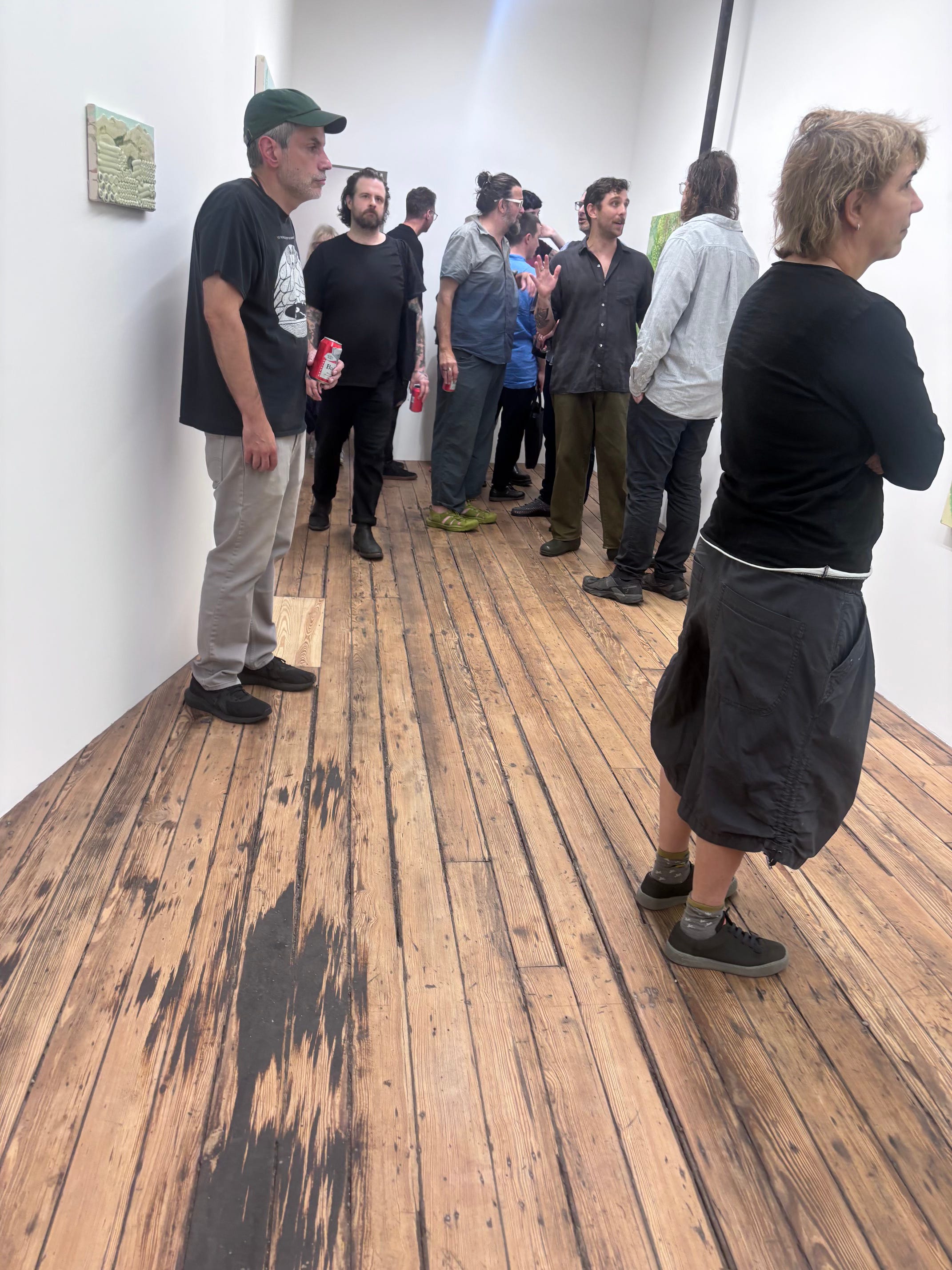
As I move through the space looking for Broc Belgin, the gallery’s owner, I find him taping down wires because apparently even gallery owners spend opening night doing facilities management. Broc, a longtime Daddy friend and supporter, and I catch up about the summer and the general art world madness of September. We discuss the show, survey the room, and when he spots a longtime, well-known artist, I practically push him toward them because Daddy remains committed to facilitating other people’s social lives against her will.
From there, a mutual friend and I catch up before they bring me to the backyard. One minute I am discussing art, and the next I am being led through a series of Chinatown Narnia doors into a concrete backyard I had somehow never seen in three years of going to the gallery. Surrounded by metal fencing and the backs of the buildings around it, it is like seeing the street reversed, stripped of the storefronts and sidewalk crowds outside. Two younger DJs blast house and techno while I drink a Spindrift and attempt to remember the art I have just seen.
I look at my phone, and what seemed like 20 minutes has turned into almost an hour. I still need to head to the belly of the beast: Tribeca. I make the only sane and adult call available to me. I order a Lyft.This allows Daddy to sit in AC for ten minutes, decompress between neighborhoods and, most importantly, arrive in Tribeca without upper-lip sweat.
The Toyota Sienna arrives, which, along with the Camry, seems to make up the official Daddy fleet whenever I order a car. I am whisked through the back streets of Chinatown during arguably one of the city’s busiest nights: Tribeca gallery openings and NYFW. My chauffeured minivan experience is short but earned.
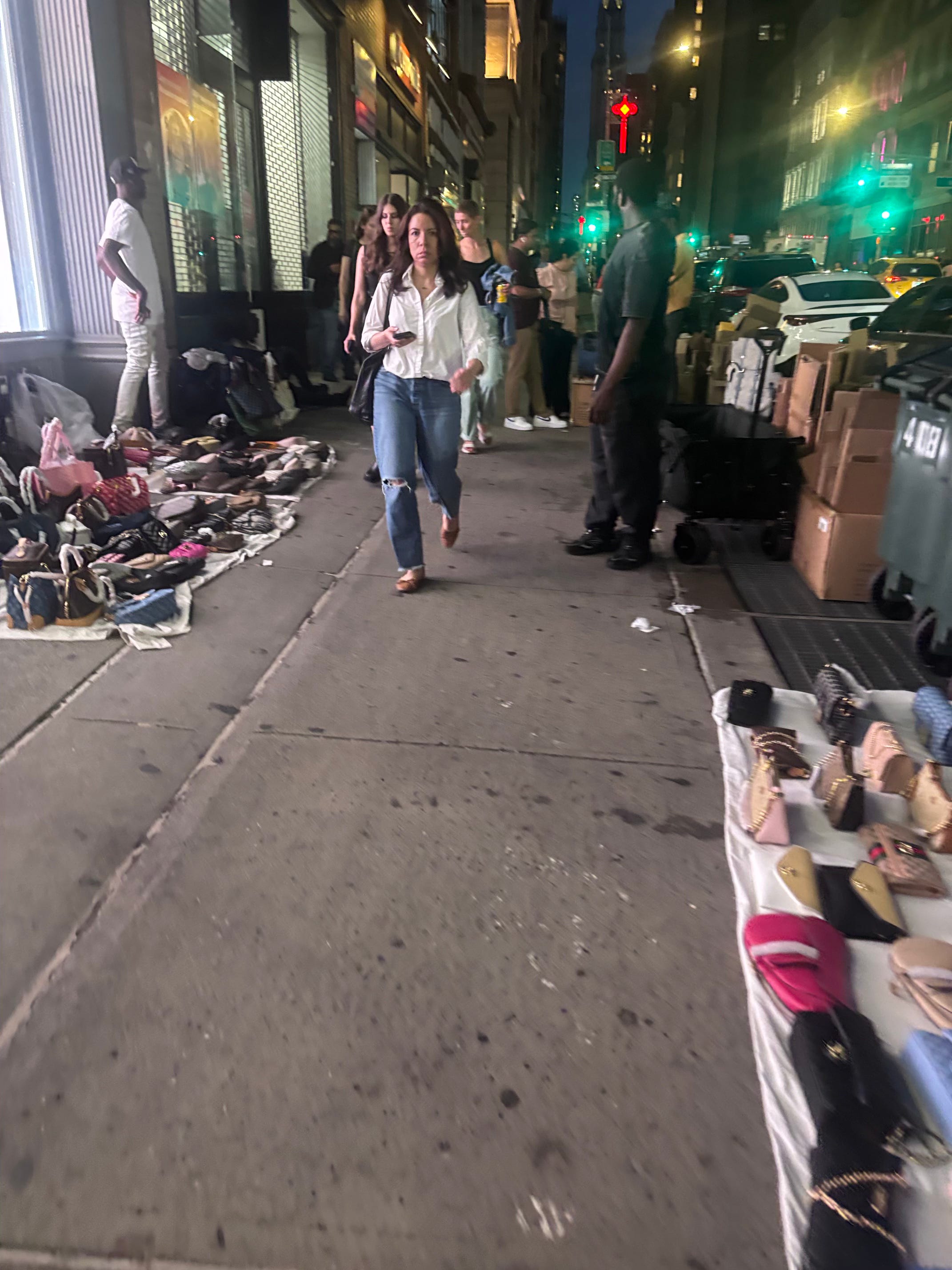
I arrive at the corner of Canal and Broadway, slide out of the Sienna, slam the door and am immediately returned to civilian life. The street vendors have become increasingly dense, like a tropical rainforest jungle. The overflow of knockoff LV bags, Chanel wallets, Apple products, watches and other items is staggering.
We are all fighting for every available inch of sidewalk, a rapidly disappearing natural resource in Lower Manhattan. The tourists stop every two seconds to look and haggle. I attempt the NYC speed-walk, weaving and bobbing through the crowd like a boxer while trying not to take out an entire family with my tote bag. I can spot the eager art students a mile away. I stay clear. I have already taught this week.
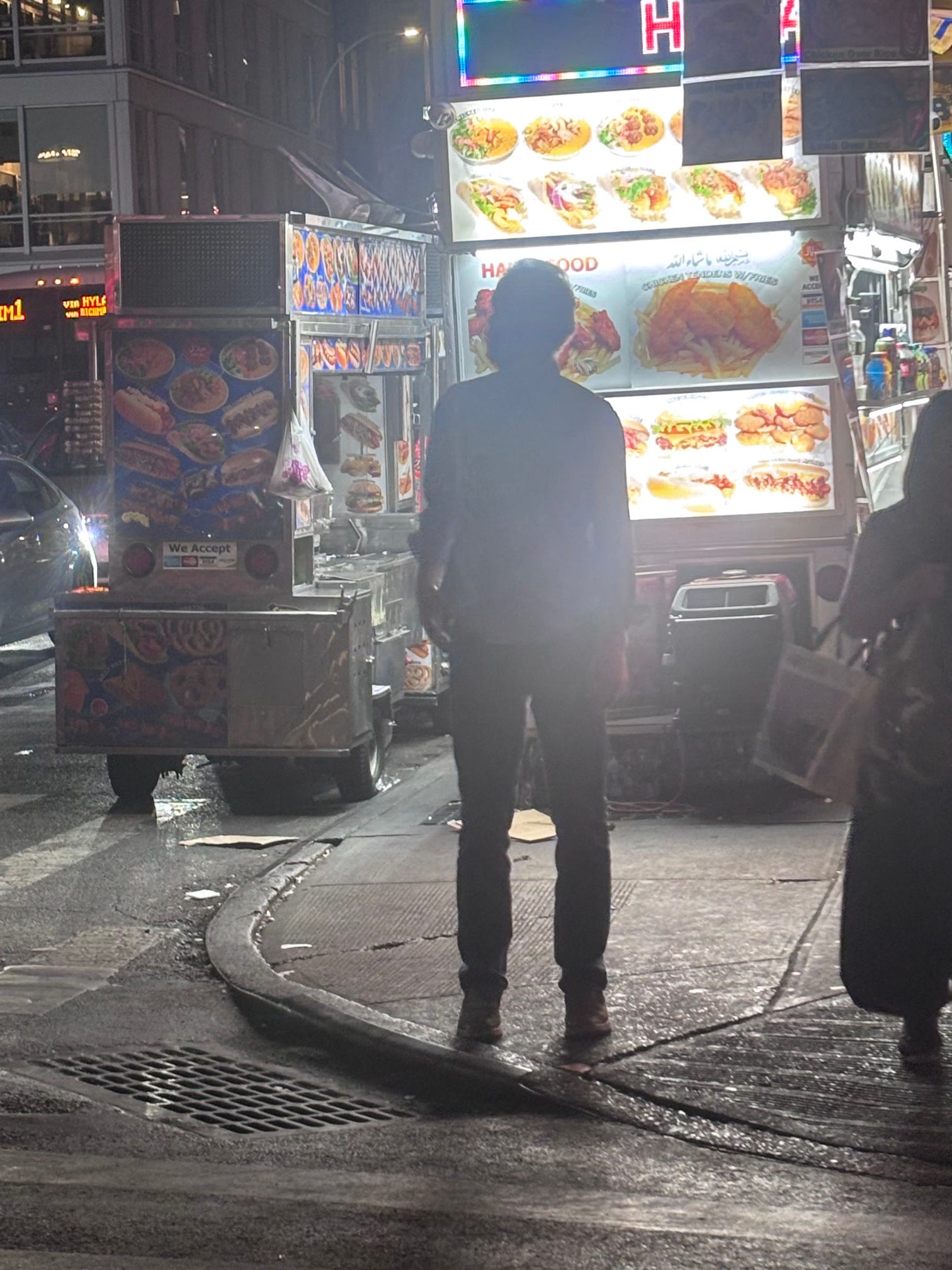
I make my way up the stairs to the second-floor DIMIN and am greeted by an aluminum door installed in the entrance. I had seen install shots on the gallery’s social media over the last few days and was intrigued, but the door makes the show announce itself before I am even fully inside.
Taj Poscé: Looking Up From Here, on view through October 24, transforms the gallery into an extension of the paintings themselves. The door, titled In & Out My Door (Freedom Flyer), is a replica of the front door of Poscé’s great-grandfather’s house. Before you’ve even properly entered the gallery, you’re walking through someone else’s history. It’s a smart move that sets the mood for the entire show, introducing ideas of memory, family and inheritance before you encounter a single painting. Memory here isn’t something being recalled from a safe distance. Poscé makes it something you physically have to pass through. And the slam the door makes behind you only reinforces this.
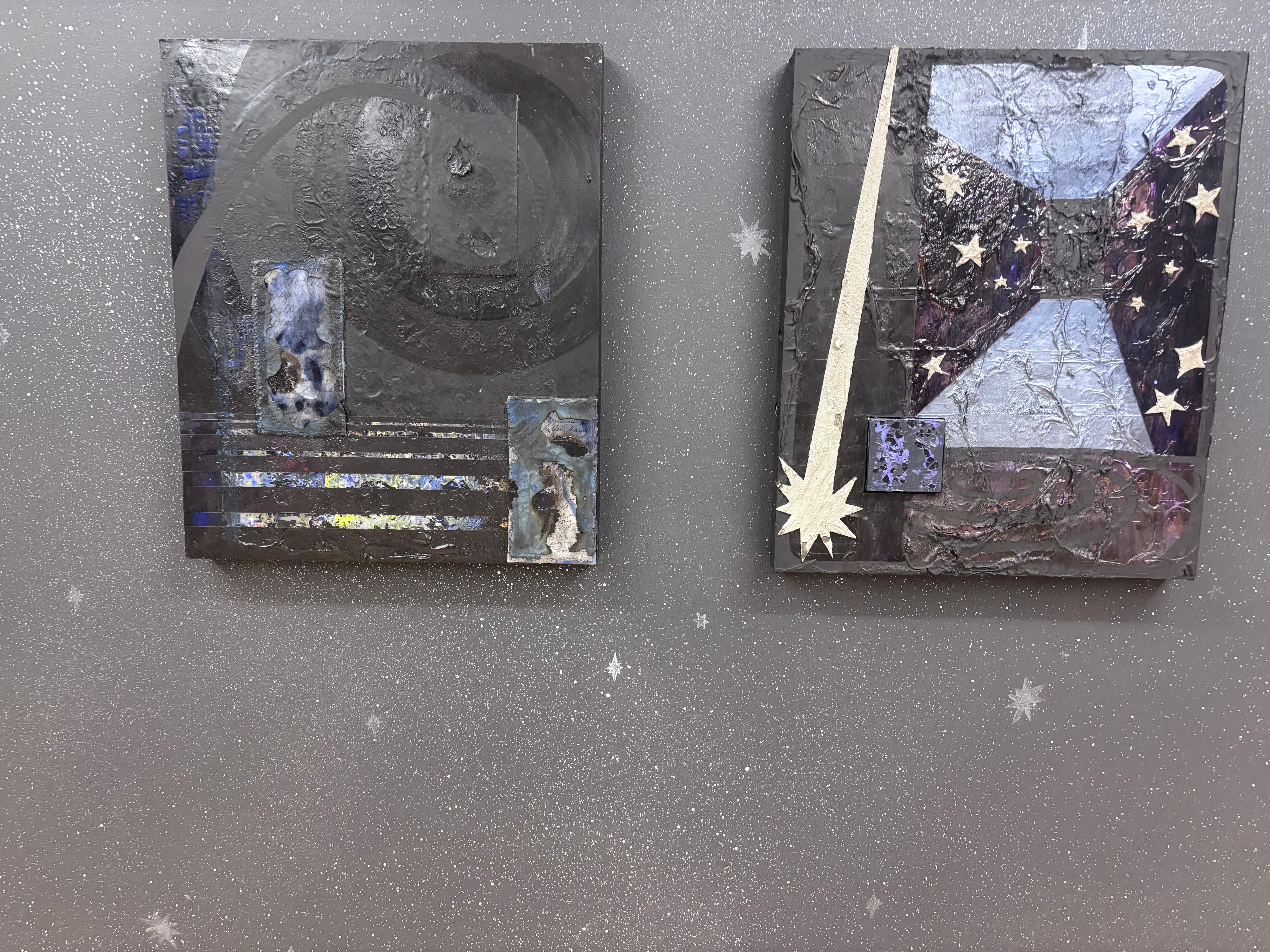
That idea carries into the paintings themselves, which are materially dense, combining photographs, tin foil, different kinds of paper, plastic and more. There’s a lot going on, but it doesn’t feel like Poscé threw the contents of a craft drawer at the wall and hoped for the best. Instead, the accumulation is the point. The layers begin to function like memory itself: things collected, inherited, distorted, held onto, buried and rearranged over time. Materials overlap without completely obscuring what came before them, allowing personal history to sit alongside larger questions of identity, labor and race without the work turning into an art-school seminar about any of them.
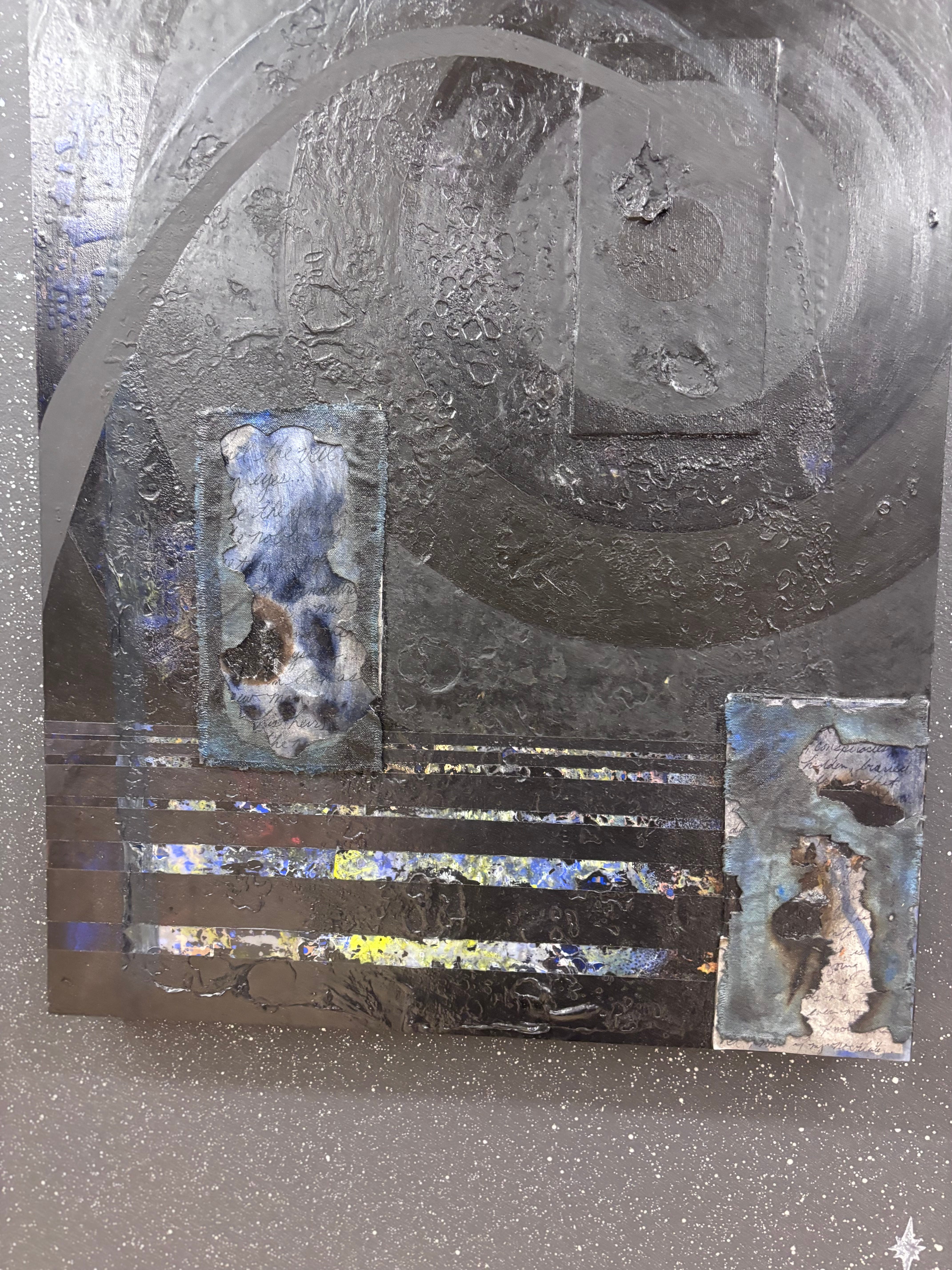
This is Poscé’s second solo show at DIMIN, and by the time I leave, the door has become less an introduction to the exhibition than a proposition for everything that follows. We inherit histories, objects, images, families and ways of understanding ourselves, but Poscé’s work is interested in what happens after inheritance. What do we keep? What gets distorted? What do we bury? And how much of what remains can we rearrange into something of our own?
I do another spin around the gallery, say hello to gallery owner and Daddy friend Rob Dimin and his wife, Justine Hill, and eventually make my way to the Roxy, where I have officially earned a martini. Surrounded by artists, writers and other art-goers, I listen to live jazz while one conversation debates the best works at this year’s Biennale and another turns to labor issues in universities. After several hours of art-world tactical operations, Daddy briefly experiences what appears to be adulthood.
Thursday, September 10, 5:13 p.m.
I am in a bathroom stall in the cellar level of a CUNY college. I ended class early to get to openings on time and, more importantly, to change before said openings. I take a black dress out of a plastic shopping bag, pull my Paris Review T-shirt and black skirt off over my head, and put the dress on. I tie a patterned ribbon around my waist and apply more deodorant.
Through the small crevice between the stall door and its frame, I can see a steady stream of students and professors filing through. I use my cell phone in photo mode as a mirror and quickly apply makeup. I flush the toilet before opening the door, shove my clothes into the plastic shopping bag and my makeup into my tote, wash my hands and make my way to the 6 train.
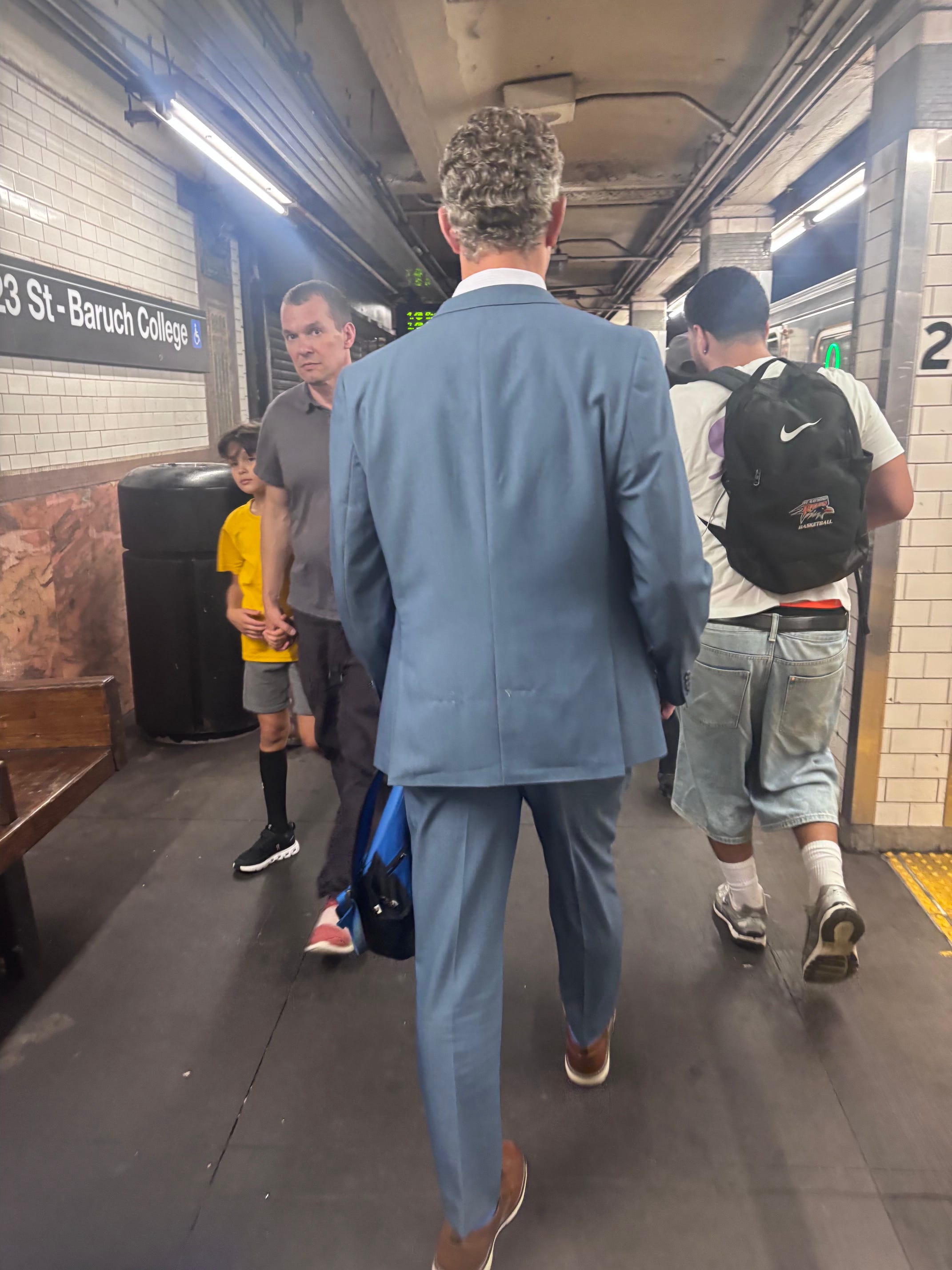
I get on and immediately spot a silver fox. I take a picture of him. I track him for several stops before getting off at 23rd and making a run for the bus. He and I disappear into the NYC late-summer evening.
I arrive in Chelsea at almost exactly 6 p.m. I spot the seasoned art-goers a mile away and stay clear. With my headphones and sunglasses on, I trudge on to 22nd Street in hot pursuit of the openings and unleash myself into the art-world Hunger Games for real. The sidewalks are already swelling with people, and I walk with purpose into the first official Thursday of the fall art season.
I head to Matthew Marks for Leidy Churchman’s solo show at the gallery’s 522 location. The exhibition combines small sculptures displayed in boxes on podiums with more than ten new paintings that vary dramatically in size, the largest stretching over six feet. The works are expressive, absurd and vibrate with energy. I find myself as drawn to the larger paintings as I am to the people filling the space.
Less than an hour ago, I was changing clothes in a bathroom stall at CUNY. Now I find myself in conversation with David Velasco, one of the most influential art editors of the last decade who also teaches at CUNY. David has a book coming out. I have a Substack. We talk shop and lament adjuncting and the respective dumpster fires of higher education and art media.
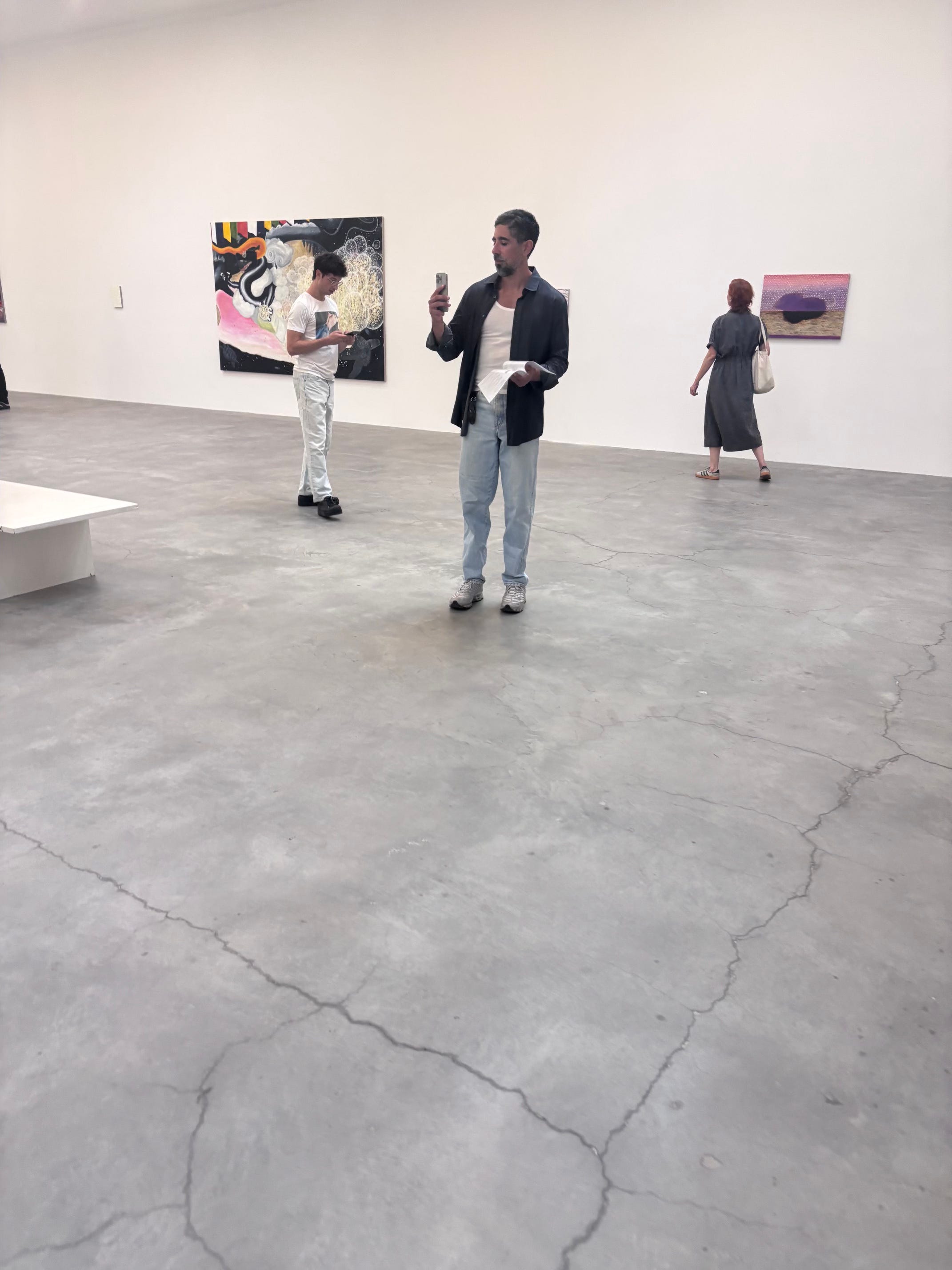
He heads off and I linger in the gallery to look at the works. A random man compliments my tattoos, and I trail off to document more people. I head outside and within two seconds spot Sarah Friedlander from Christie’s. I spot a billionaire and maybe 45 seconds later, Darius Himes, Christie’s International Head of Photographs. Darius is OG Daddy material. Darius and Daddy don’t talk. Darius has no idea who I am. Darius is out with a younger woman. I take a photo and continue to mind my own business.
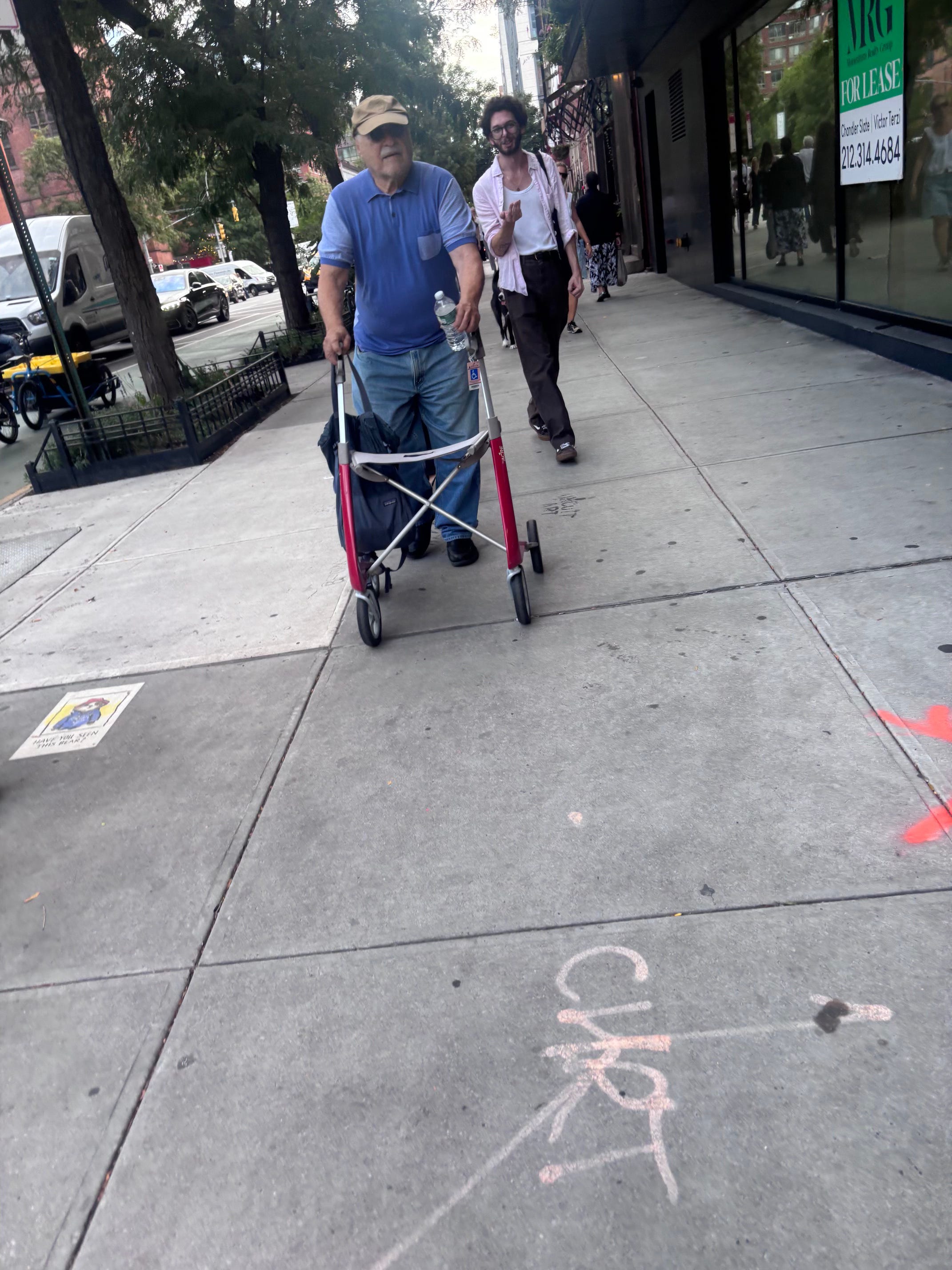
I slip past the crowds and into Sikkema Malloy Jenkins.The gallery is packed, and I move through the crowd like a seasoned member of an art-world tactical team. I make my way through the first major gallery spaces, clocking the large, colorful paintings but looking for something to really stop me in my tracks.
The gallery is packed, and I move through the crowd like a seasoned member of an art-world tactical team. I make my way through the first major gallery spaces, clocking the large, colorful paintings but looking for something to really stop me in my tracks.
I turn the corner into the second gallery and there is artist Malcolm Peacock beside two very large drawings on the floor. He is in a tank top, black shorts and clogs, standing on a deep purple bandana and eating an enormous mango. It may be one of the biggest mangoes I have ever seen in my life. I am mesmerized. I stop and start taking photos and videos. Peacock eats the mango methodically with both hands as juice runs down them. The crowd along the gallery walls starts to thicken, but I stay put.
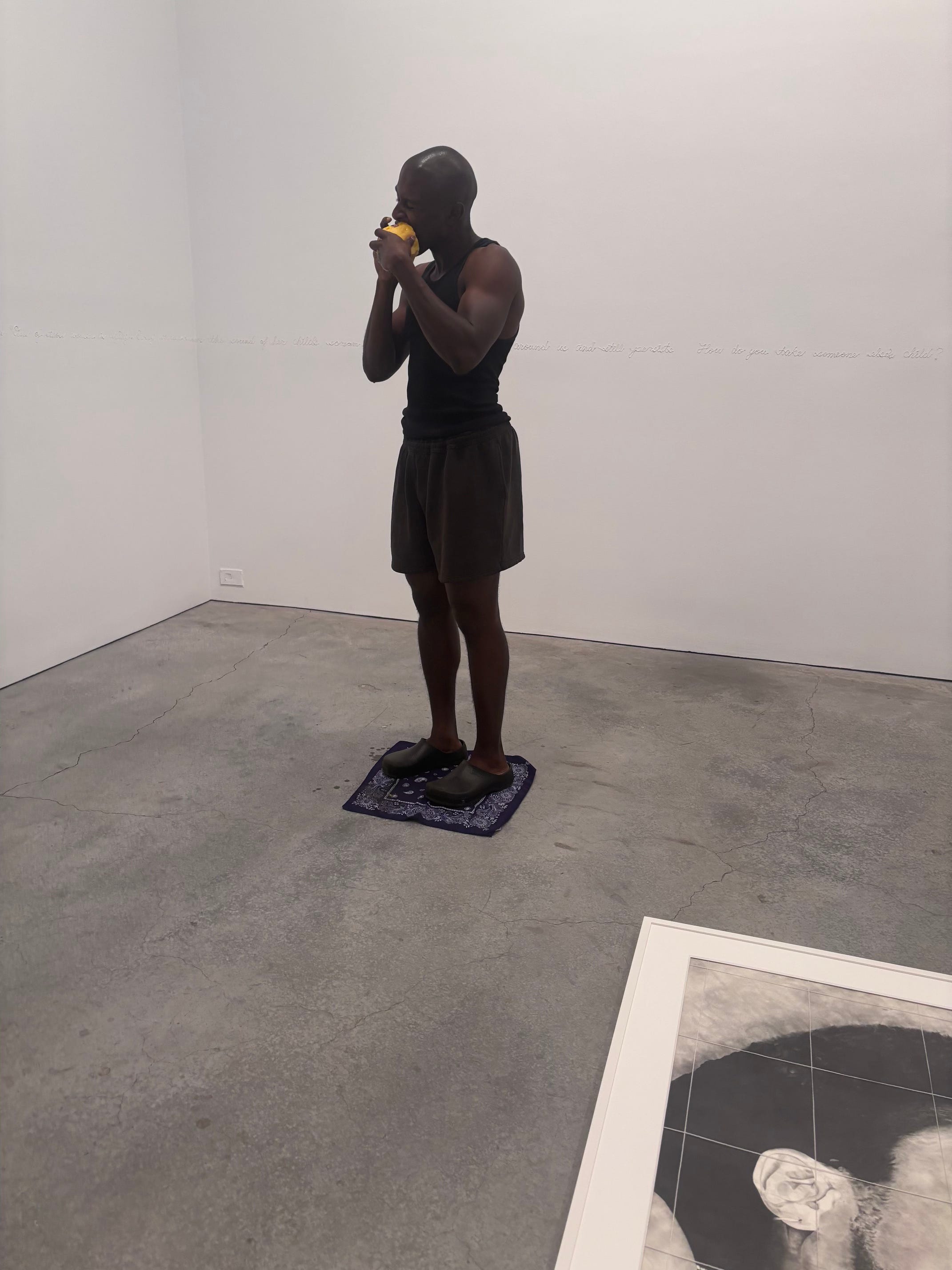
It’s Peacock’s first show with the gallery. While he eats, I take in the entire installation around him: enormous drawings on the floor, suspended sculptures, braided synthetic hair, reliefs and works on paper. His practice uses endurance and repetitive physical actions like braiding, running, talking and, in this case, eating to think about intimacy, time and what happens when bodies occupy space together. There is so much happening at once, but none of it feels incidental. The longer I stand there, the more the performance and everything surrounding it begins to collapse into one experience. It is strange, intimate, physical and hypnotic, and some of the best work I have seen all year.
I leave feeling buzzy. I duck into Hauser & Wirth next. I am here for Hans Arp because that is something that will always be in season.
I get in the door, turn the corner and am automatically greeted by someone from the Hauser team. We spend the next 20 minutes talking about the art world, gossip and the upcoming fairs. I am very emphatic about my feelings on the Independent 20th Century at Sotheby’s and how the whole thing feels like a collapse of the invisible wall between galleries, auction houses and the secondary market. I admit that I have named the whole thing a turducken because that is the only way I can understand its existence.
I spot Bill Powers, excuse myself to take a discreet picture and disappear upstairs to the Hans Arp show.
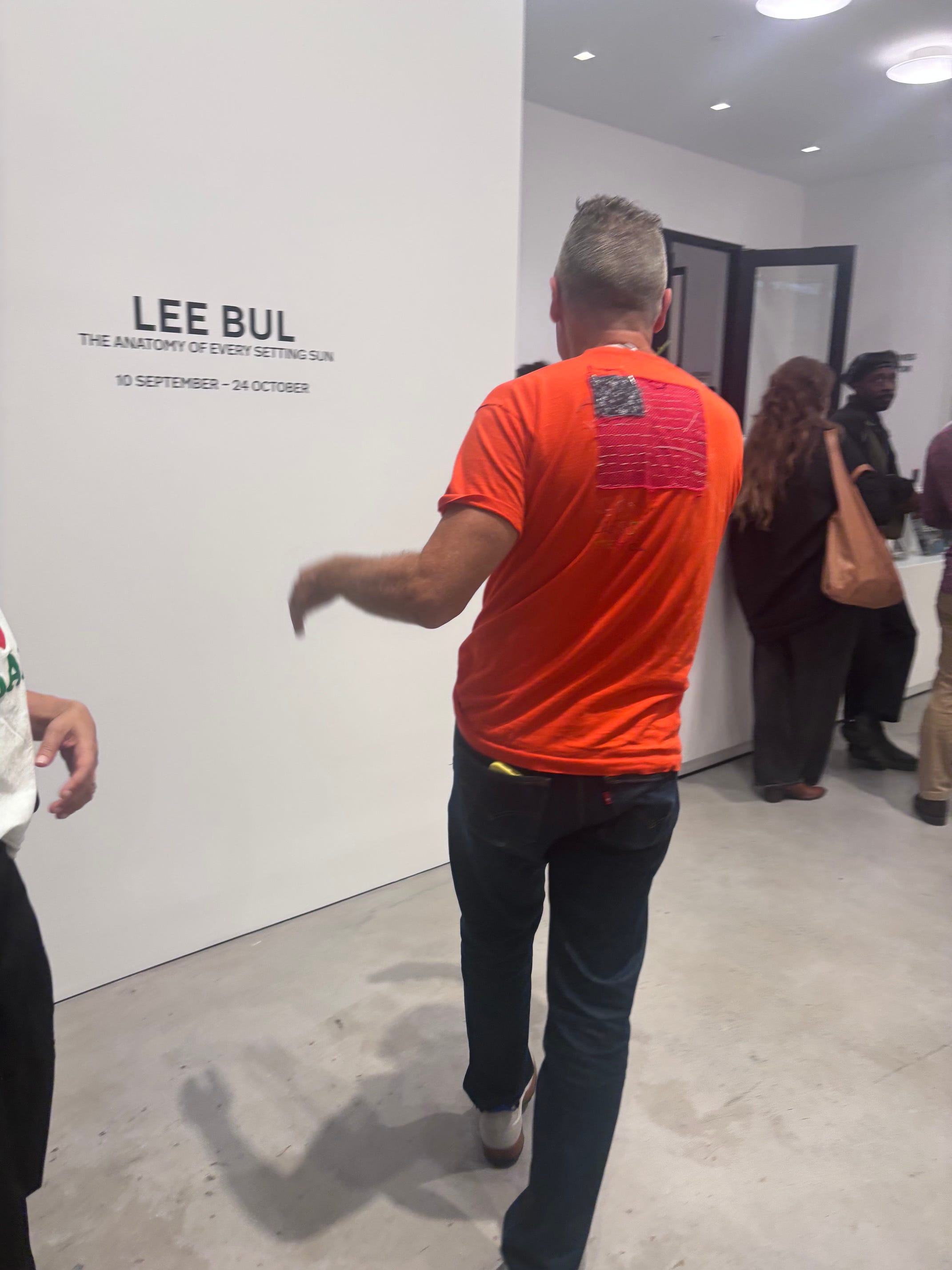
The Arp show is gorgeous because it’s Hauser and it is always going to be well executed, but I take issue with the presentation of the prints. Many of them are arranged side by side on shelves, and something about it just isn’t working for me. I find myself secretly hating the install while still snapping pictures because, well, it’s Hans fucking Arp.
I leave Hauser and keep moving. I have eight more galleries on my list and make my way through them at a much faster clip. Somewhere along the way, word reaches me that Jeff Magid is also in Chelsea. I consider finding him, but at my next stop I get caught up in conversations, someone hands me wine and whatever tactical operation I thought I was running begins to fall apart.
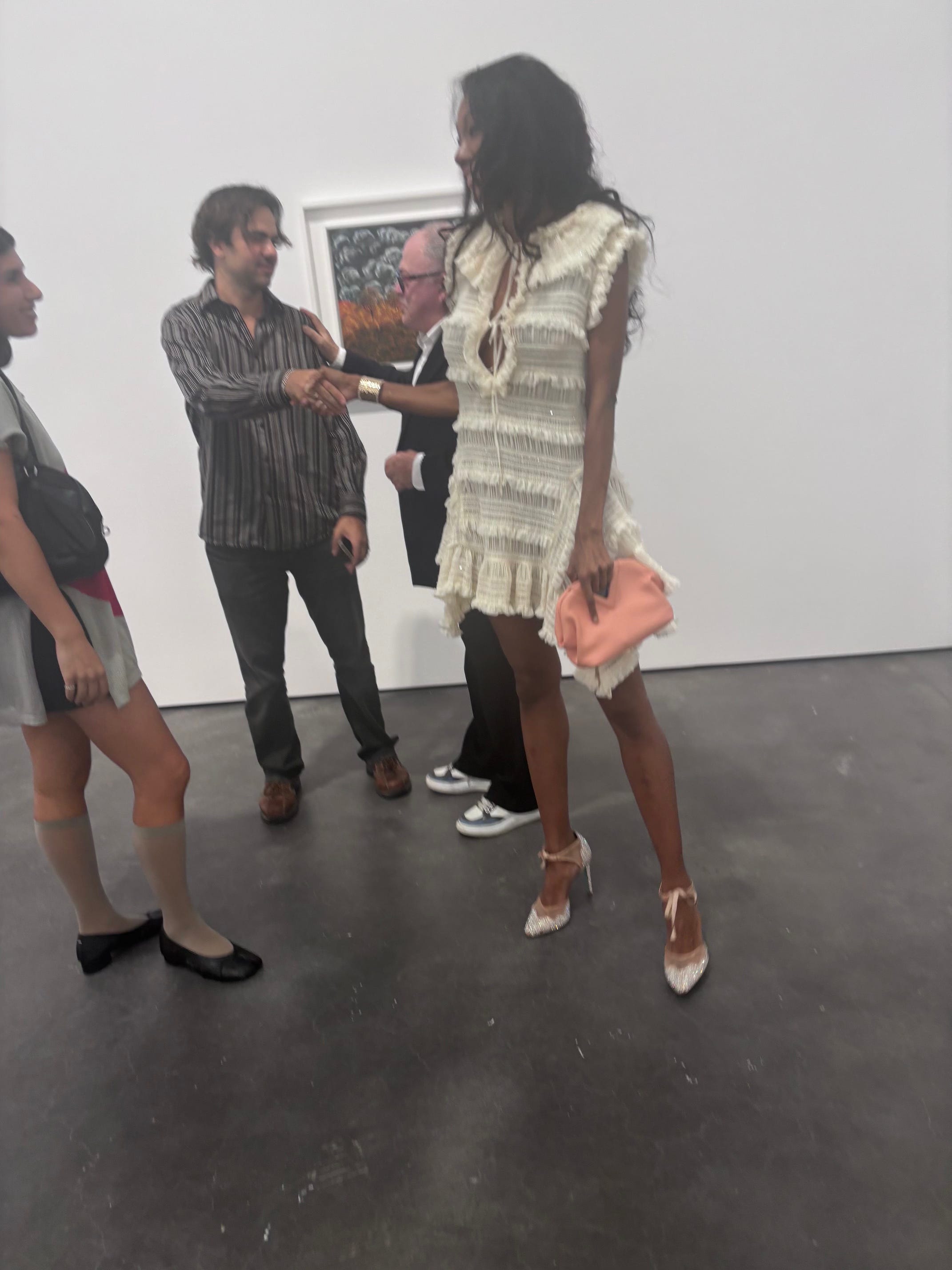
Eventually I make it to Scott Kahn at Zwirner, where I meet up with a friend. I spot a man I am later told is a collector accompanied by a woman who looks like she may have stepped out of a fashion campaign or is possibly a paid date. Neither is wrong. All of it is entirely the art world. Either way I think,”Good for her.” The entire tableau is bizarre enough to hold my attention. My friend fills me in on some Kahn drama, introduces me to a friend of hers who is an artist, and eventually we all realize we are fucking starving.
We spill back onto the sidewalk in search of food. Every restaurant in Chelsea is packed. We eventually get a table at an Italian place where I know the manager because of course I do, and over wine and pasta I explain that he needs to download Seesaw so he knows when the openings are happening and can prepare accordingly. Apparently I am now providing emergency art-world logistics to the Chelsea restaurant industry.
I finish my wine and pasta, say goodbye to everyone and order an Uber home to Brooklyn. A few minutes later, a Toyota Sienna appears because of course it does.
I get in, open Instagram and immediately start downloading the night into pictures on my feed. Daddy may be going home, but apparently I am still working. By the time I get home, I am still answering DMs. I feed the bunny, shower and get into bed. I take a sip of water, lie down and hope my liver can survive the next three months of openings.
In so many ways this missive from the front was better than being there.